The V-Model
Digital Innovation Agents is built around the V-Model, a sequential development process that bends in the middle. The left side is design (what are we building?), the bottom is implementation (build it), and the right side is verification (does it work? is it safe?). Each left-side phase has a matching right-side phase that verifies it.
Why the V-Model?
Traditional AI coding sessions look like this:
User idea -> Agent writes code -> PRThat skips everything that matters for real projects: understanding the problem, defining the solution scope, making deliberate architecture decisions, verifying the implementation. Small features survive this shortcut. Anything bigger does not.
The V-Model forces a deliberate path:
- Understand the problem before designing the solution
- Define requirements before making architecture decisions
- Design the architecture before implementing
- Verify tests before running a security audit
- Audit security before releasing
Every phase produces artifacts that the next phase reads. Nothing is ad-hoc, nothing is only in the agent's head. Everything lives in _devprocess/ so you can review, audit, and reproduce.
The six phases plus closing handoff
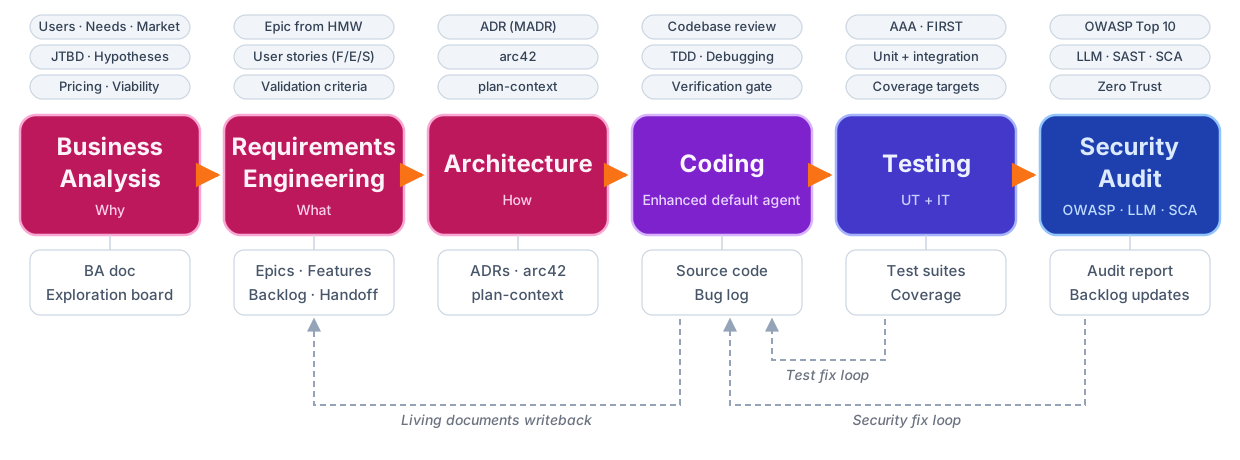
The design phases (BA, RE, Arch) sit on the left. Implementation (Claude Code) is in the middle. Verification (Testing, Security) is on the right. Each phase produces a durable artifact below it, the fix loops iterate until tests pass and findings are resolved, and the review sync keeps architecture decisions in sync with the real codebase.
Phase 1: Business Analysis. Exploration, Ideation, Validation. Produces the Project-BA BA-{PROJECT}.md (singleton, product layer with personas, HMW question, value proposition, idea potential, and critical hypotheses) plus per-item Item-BAs (BA-EPIC-{nn}-{slug}.md, BA-FEAT-{ee}-{ff}-{slug}.md, optional BA-IMP-*.md and BA-FIX-*.md) that feed the corresponding backlog artefacts via ba-ref:.
Phase 2: Requirements Engineering. Transforms the BA into Epics, Features, and tech-agnostic Success Criteria. Produces the architect-handoff.md.
Phase 3: Architecture. Creates ADRs (one per Critical ASR), arc42 documentation, and the plan-context.md context bridge.
Phase 4: Coding. Critical review against the real codebase, implementation with task-level guidelines, writeback to all artifacts. This is the bottom of the V.
Phase 5: Testing. Integration tests, unit-test gap-filling, fix-loop until all tests are green.
Phase 6: Security Audit. OWASP Top 10, OWASP LLM Top 10, SAST, SCA, Zero Trust. Fix-loop until all critical findings are resolved or explicitly deferred.
Closing Handoff (not a phase). After a green /security-audit, the guide recommends /consistency-check mode B, outputs a closing report (Feature/bug/security counts, finalised artifacts), and queues the post-release BA review as a BACKLOG row. The actual release act (version bump, merge, tag, publish) is delegated to a project-specific release skill outside the public DIA plugin.
The traceability chain
Every artifact traces back to the one that produced it:
BA document (Why?)
  -> Epic (What, strategic?)
    -> Feature (What, concrete?)
      -> ASR (What is architecture-relevant?)
        -> ADR (How do we solve it?)
          -> plan-context.md (Context bridge)
            -> Critical Review (Does it fit the codebase?)
              -> Code
                -> Tests (Does it work?)
                  -> Security Audit (Is it safe?)
                    -> Closing Handoff (consistency-check mode B + optional release)
If you open a random line of code, you can walk backwards through this chain and end up at a business motivation in the BA document. No orphans, no "we added this because it seemed useful".
Why the writeback matters
Every step in this chain also writes backwards. When /coding finds that an ADR does not match the real codebase, it updates the ADR before implementing. When a bug is fixed, the FIX-{ee}-{ff}-{nn} row in BACKLOG.md carries the commit SHA, and the detail file under _devprocess/requirements/fixes/ carries the regression test. When a Feature's Success Criterion cannot be met as specified, the Feature file is updated with the reason.
This is the Living Documents pattern. It keeps documentation in sync with reality. The Three-layer documentation model explains why state lives in the backlog row and substance lives in the detail artifact, never both.
Phase transitions
Every phase ends with a mandatory 3-part Handoff Ritual (artifact report, phase-end commit with DIA trailers plus tag-phase, transition question). The pre-commit hook enforces the drift-critical graph invariants on every commit; the full /consistency-check runs before release. The V-Model workflow guide drives transitions when you run /dia-guide. Individual phase skills run the ritual too when invoked directly.
The V is iterative, not linear
The diagram above shows a straight walk from Phase 1 through the Closing Handoff. In practice the V is a decision graph. Real projects discover things mid flight: a bug surfaces during /coding that nobody predicted, an architectural choice turns out to be wrong once the code exists, a FEAT spec reveals a gap once you try to design around it, and sometimes coding hits a capability the architecture never anticipated.
Four cross-phase feedback triggers make the iteration explicit:
- Mid-course bug discovery in
/coding. A new bug pauses the implementation. Triage routes the issue to a fix or a feature, root cause analysis lands in the FIX detail file, and theFIX-{ee}-{ff}-{nn}backlog row appears BEFORE any fix gets written. - Mid-course design discovery in
/coding. An ADR no longer matches reality. The coding flow pauses, amends or supersedes the ADR, updatesarc42.md, the wayfinder, andplan-context.md, and only then continues the feature. - Mid-course requirements discovery in
/architecture. A FEAT spec has a gap or an impossible constraint. Architecture pauses and routes the issue back to/requirements-engineeringfor a FEAT update. - Mid-course capability discovery in
/coding. The implementation needs something the architecture never planned (a new library, a new infrastructure component, a new pattern). The coding flow pauses, captures the capability gap as an ADR, and routes back through/architectureto integrate the decision before the implementation continues.
Each trigger follows the same 6-step pattern (STOP, triage, root cause, backlog, change with commit Refs, Final sync). The forward walk remains the default. Iteration is an option, not a detour.
Scope adaptation
The same V-Model runs for:
- Simple Test / Feature (hours to 1-2 days): minimal Exploration, skip Validation, focus on Definition of Done
- Proof of Concept (1-4 weeks): shortened Exploration, full Ideation, hypothesis-driven Validation
- Minimum Viable Product (2-6 months): full Exploration, full Ideation, complete market Validation
The phases are the same. The depth adapts.
See also
- V-Model workflow guide: the guide
- A full V-Model run tutorial: end-to-end walkthrough
- Living Documents: the writeback pattern
- Handoff Rituals: phase transitions